
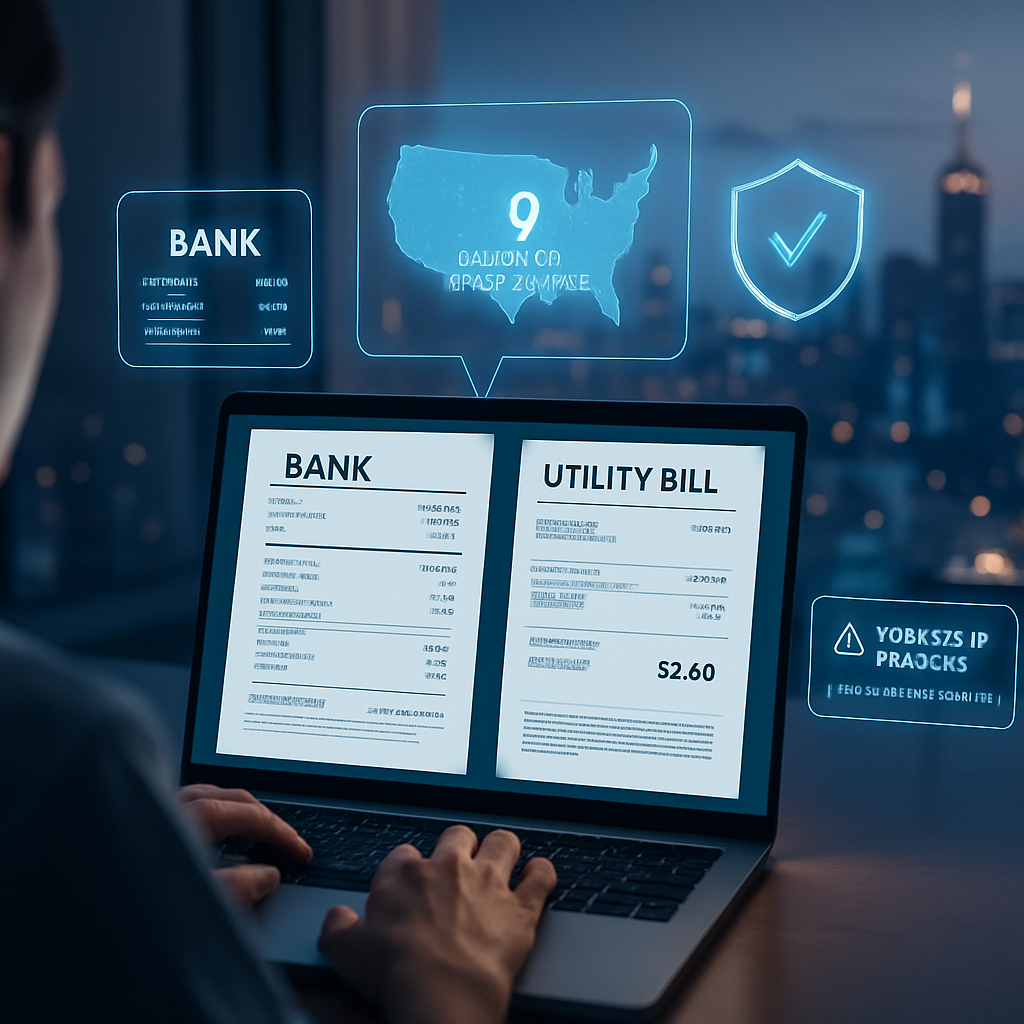
Managing US bank account address verification while traveling abroad presents unique challenges, especially when accessing accounts from foreign IPs can lead to unexpected restrictions. Maintaining up-to-date proof of US address documentation is essential to prevent freezes and ensure continuous access. Editable document templates offer a streamlined, consistent way to prepare necessary records like bank statements and utility bills that comply with US bank address verification requirements.
This guide explains key practices to maintain a valid US bank account address verification remotely, highlighting the types of accepted documents and how customizable templates improve speed and formatting accuracy. You’ll also learn how to navigate potential complications with virtual addresses and foreign IP banking restrictions, supported by practical strategies to keep your account active while abroad. For ready-to-use resources, explore our collection of bank statement templates designed to assist with address documentation needs.
Next, let’s explore how these templates can help maintain consistent proof of US address and what steps you can take to avoid interruptions during your international travels. These templates are intended for design practice, mockups, and film props; they are not substitutes for official documents.
Ensuring valid US bank account address verification is critical for travelers to prevent account restrictions while abroad. This guide highlights key practices for maintaining acceptable proof of US address remotely, supported by editable document templates and informed strategies.
- Understand US banks’ proof of address policies: Banks require verifiable US residential addresses to comply with regulatory standards and prevent fraud.
- Recognize foreign IP risks: Accessing accounts overseas can trigger freezes if address verification and usage patterns appear inconsistent.
- Use accepted proof of address documents: Utility bills, bank statements, and lease agreements serve as primary verification materials.
- Leverage editable proof of address templates: Customizable bank statement templates can help maintain valid documentation reflecting a US address while traveling.
- Explore virtual US address options cautiously: Not all banks accept virtual addresses; verify your bank’s requirements to avoid account complications.
- Maintain consistent communication with your bank: Informing your institution about travel plans reduces unexpected freezes linked to unrecognized foreign activity.
- Hidden insight—remote address verification opportunity: Emerging solutions enable travelers to provide compliant address proof without physical US presence using editable documents for streamlined verification.
- Access professional resources: Consider reviewing specific bank statement templates designed for address verification needs.
Next, we’ll explore how to utilize these templates effectively and navigate banking policies to secure uninterrupted access to your US bank account abroad. These templates are intended for practical documentation and design use; they are not substitutes for official proof of address required by banks.
Understanding US Bank Account Address Verification Requirements
Why US Banks Require Proof of Address
US banks mandate verifiable residential addresses primarily to comply with federal regulations such as the USA PATRIOT Act, which emphasizes customer identification and fraud prevention. Proof of address reassures banks about the legitimacy of the account holder’s residence, ensuring secure management and safeguarding against identity misuse. It forms a critical part of anti-money laundering efforts and helps financial institutions maintain trust with regulatory bodies.
Common US Bank Address Verification Policies
Banks typically require address verification during account opening and periodically thereafter, especially if discrepancies or account irregularities arise. Most institutions accept documents issued within the past 30 to 90 days that display the customer’s name and current physical address. Common policies include restricting acceptable document types (utility bills, lease agreements, bank statements) and requiring format consistency to ensure verification integrity. Some banks also implement automated validation systems that cross-check submitted addresses against public databases.
Implications of Inconsistent or Missing Address Verification
If an account holds outdated or conflicting address information, banks may impose restrictions such as limiting transactions, initiating manual reviews, or temporarily freezing the account. This becomes especially evident when suspicious activities occur, like access from foreign locations, triggering compliance alerts. Hence, failure to maintain up-to-date proof of address can lead to service interruptions and delayed access, complicating financial management for the account holder.
Having a clear grasp of these requirements sets the stage for understanding the risks tied to accessing US bank accounts from abroad.
Risks of Accessing US Bank Accounts From Abroad
Foreign IP Banking Restrictions and Their Impact
Many US banks deploy geo-fencing and advanced fraud detection tools that flag or block logins originating from foreign IP addresses. These security features aim to prevent unauthorized access but can inadvertently affect legitimate users traveling internationally. The impact ranges from added authentication steps to outright account locks, causing inconvenience and delay in accessing funds or conducting transactions.
Understanding Bank Account Freezing Due to Address Verification Issues
When foreign access coincides with discrepancies in the recorded US address data—such as missing or outdated proof of residency—banks escalate security protocols. This often leads to temporary freezing until the user verifies their identity and confirms their current address. Such freezes protect the account but require prompt submission of valid address documentation to restore functionality.
How Maintaining Valid Proof of US Address Mitigates These Risks
By proactively updating and submitting accepted proof of address documents, account holders reduce the likelihood of disruption during travel. Banks are more confident in authentication when the residency details align with access activity, which can lessen the frequency of security challenges. Additionally, carrying editable document templates configured with correct locale formats and needed details facilitates swift compliance and communication with banking institutions.
With these risks in mind, knowing which documents are acceptable becomes crucial for account holders managing their address verification remotely.
Accepted Documents for Proof of US Address
Primary Verification Documents: Utility Bills, Lease Agreements, and Bank Statements
Among the most widely accepted proofs of address are recent utility bills (electricity, water, gas), current lease or rental agreements, and official bank statements issued by recognized financial institutions. These documents must clearly show the customer’s full name, consistent US address, and be dated within the required time frame stipulated by the bank—usually within the last 60 to 90 days. Notably, digital copies with visible issuer information and unaltered formats are preferable.
How to Choose the Right Document for Your Verification
Select documents that align closely with your bank’s specifications and policies. For example, some banks may prefer utility bills over bank statements to prevent circular referencing. Prioritize documents that contain stable and permanent address details rather than temporary or transient ones. Additionally, ensure all personal information matches existing bank records exactly to avoid processing delays.
Tips for Maintaining Document Validity Remotely
When physically distant from your US residence, maintaining valid proof of address can be challenging. Key strategies include:
- Setting up electronic delivery of utility bills or bank statements to an accessible email or cloud storage
- Using mail forwarding services with verified US addresses that comply with your bank’s acceptance criteria
- Regularly requesting updated digital documents directly from your service providers or landlords
These approaches help ensure you have timely, legitimate documentation ready for submission when address verification is requested.
Next, leveraging editable proof of address document templates can accelerate and simplify this process.
Utilizing Editable Proof of Address Document Templates
Advantages of Using Editable Bank Statement Templates
Editable templates designed for bank statements or utility bills offer significant benefits for managing address verification efficiently. They allow consistent formatting across multiple document versions, reduce manual errors in data entry, and enable rapid updates to essential details such as address changes or billing periods. For travelers, this means quicker turnaround times in preparing documents aligned with bank requirements during remote verification processes.
How to Customize Templates for US Bank Account Address Verification
- Ensure accurate display of US residential address: Use separate, clearly labeled text fields for street, city, state, and ZIP code to avoid data overlap and improve readability.
- Maintain correct locale, currency, and date formats: Adopt US-standard date formats (MM/DD/YYYY) and dollar currency symbols to match bank expectations and support automated processing.
- Align tables and data fields to bank standards: When dealing with invoice or billing data, use consistent table borders, column widths, and text alignment to replicate official document aesthetics.
Recommended Editable Document Resources
Professionally designed templates that meet verification standards can be sourced from reliable providers. For instance, the US bank statement templates offer ready-to-edit Word and PDF formats, compliant with typical bank submission guidelines. Similarly, utility bill templates support multi-format customization with locale appropriate styling. Utilizing these tools reduces preparation time and ensures document quality when verifying your US address.
Having accurate and compliant document templates in hand naturally brings attention to the role of virtual US addresses amid international banking challenges.
Conclusion
Effectively navigating US bank account address verification requires a clear understanding of regulatory demands, common policies, and the risks linked to inconsistent proof of address—especially for individuals accessing accounts from abroad. Maintaining updated, accepted documents such as utility bills, lease agreements, or bank statements is essential to avoid account restrictions and delays. Leveraging editable document templates designed to match US bank standards can streamline this process by ensuring precision, consistency, and locale-correct formatting.
Employing these templates not only accelerates document preparation but also minimizes errors and supports smoother interactions with banking institutions. By adopting strategies for remote document management—like digital bill delivery and mail forwarding—account holders can confidently maintain valid address proof regardless of their location.
As financial ecosystems grow increasingly complex and mobile, integrating well-crafted, editable templates into your verification toolkit offers a practical way to uphold documentation quality and operational efficiency. Staying proactive in updating and customizing these documents sets the foundation for seamless banking experiences amid evolving compliance expectations.